- 63 views
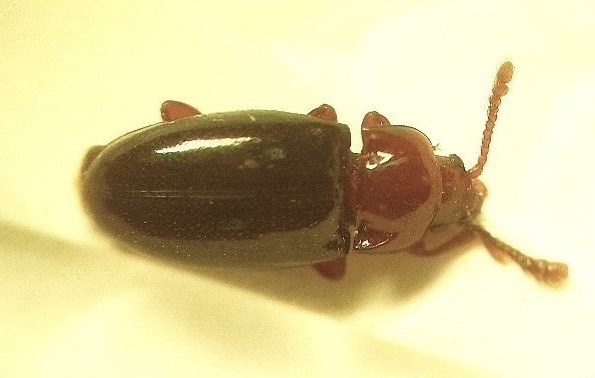
Four species of saproxylic beetles – Lymexylon navale (Linnaeus, 1758), Pediacus dermestoides (Fabricius, 1792), Leiestes seminiger (Gyllenhal, 1808) and Grynocharis oblonga (Linnaeus, 1758) – have been recorded for the first time in the fauna of the Republic of Moldova. The insects were collected in 2023 and 2024 from the scientific reserves “Plaiul Fagului” and “Codrii”. Both forest reserves have plant associations typical of those in Central Europe, being located in the south-eastern extreme of their distribution area.
Adults of the species Lymexylon navale (Linnaeus, 1758) are 7-16 mm long. They are strikingly thin, dark in colour. The male is shorter than the female. They are active from May to July, mainly at night. They are difficult to observe, as they have a hidden lifestyle and a short lifespan of only a few days. Adults do not feed, but the larvae consume hardwood, especially dead or dying oak. The species is harmful to timber and wooden shipbuilding. It is found in Central Europe. In the case of the species Pediacus dermestoides (Fabricius, 1792), adults are 3.5-4.5 mm long. The larvae are predatory, and the adults are mostly fungivorous. Adults can be collected from dead deciduous and coniferous trees. The species is widespread in the Palearctic region. Adults of Leiestes seminiger (Gyllenhal, 1808) are 2.6-3.4 mm long. The period of activity is from early spring to autumn. The species is found in Europe, the Caucasus, Iran and Japan. In Slovakia, the species is threatened with extinction and placed in the vulnerable category. It is among the very rare saproxylic beetles and is considered a relict and endangered element in Poland as well. These 3 species were collected in the "Plaiul Fagului" Reserve.
The species Grynocharis oblonga (Linnaeus, 1758) was collected from the "Codrii" Scientific Reserve. Adults are 5.5-8 mm long. It is usually found under the bark and in rotten wood of spruce, fir, birch, oak, hornbeam, alder, beech, poplar and willow. The species is active from spring to autumn. Both adult forms and larvae are mycophagous and feed on the mycelium that grows on decaying wood. The species is found in Central Europe and the European part of Russia.
This scientific novelty was reported by entomologists of the Institute of Zoology, Moldova State University, at the international scientific symposium "Current Trends in Natural Sciences", organized by the National University of Science and Technology Politehnica Bucharest, Pitești University Center, Romania, from May 22 to 24, 2025. The event took place in a hybrid format. More details about the event can be found by accessing https://natsci.upit.ro/international-symposium/.
Bacal Svetlana, PhD, Assoc. Prof.
Bușmachiu Galina, PhD, Assoc. Prof.
 1 Academiei str.
 +(373 22) 73-98-09